A festive artwork can look convincing on a screen and become difficult to read on a knitted sample. Small letters disappear, a large stitched area changes the feel of the front, or an attached motif behaves differently after care. Choosing a decoration method is therefore part of product development, not the final styling decision.
This Christmas sweater decoration guide compares jacquard, intarsia, embroidery and appliqué from a buyer’s perspective: what each approach can contribute, what to put in the brief and what to inspect. For a seasonal project, QITE’s custom Christmas sweaters page is the main product-development destination.

Start with the artwork problem, not a preferred technique
Mark the features the customer must recognise: a repeated snowflake, a large character, a short brand name or a raised fabric shape. Supply the intended artwork dimensions and position on the actual garment, not just the dimensions of the digital file.
Separate essential details from details that can be simplified. A small slogan may be more important than a shaded background. If every line and colour is declared essential, the first sample becomes an expensive way to discover that the brief has competing priorities.
For the broader design handover, use the custom ugly Christmas sweater design guide. Here, the narrower task is deciding how the motif will be constructed and what would make that construction acceptable.
| Method | Candidate artwork to discuss | Approval question that matters |
|---|---|---|
| Jacquard | Repeated motifs, patterned bands and knitted multicolour areas | Does the proposed structure give acceptable clarity, weight, stretch and reverse-side finish? |
| Intarsia | Larger, more distinct areas of knitted colour | Are colour boundaries, joins, shaping and the reverse construction acceptable? |
| Embroidery | Localised lettering, logos or stitched details | Is the artwork readable without distorting or stiffening the intended knit excessively? |
| Appliqué | Separate fabric shapes and layered surface effects | Are material, edge finish, attachment and care behaviour approved? |
These are starting points for sampling, not rules that make one method universally better. A combined construction may solve a design more effectively than forcing the whole artwork into one technique.

Jacquard: review the knitted structure as well as the picture
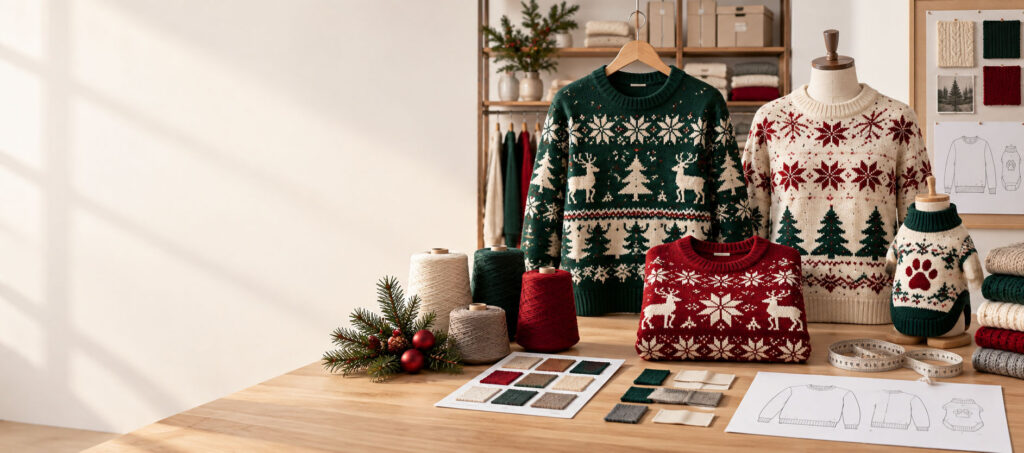
Jacquard allows colour patterning to be developed within the knitted fabric. A repeated border or all-over festive motif is a useful discussion starting point, but the front view does not tell you everything about the result.
Ask to see the actual proposed knit structure and the reverse of the sample. Review how the yarns are managed, whether there are areas prone to catching and whether the resulting thickness and stretch suit the garment. Do not accept “jacquard” as a complete description of the back construction.
Judge detail at finished size. A thin line that appears sharp in a large presentation image may be less convincing in yarn. Check the lettering, diagonal edges and smallest repeated features without enlarging a phone photograph. If the design needs simplification, approve a revised artwork version before the next sample.

Intarsia: look closely at colour boundaries and joins
Intarsia is worth discussing for more distinct areas of knitted colour, such as a large festive character or colour-block motif. The buying decision should include the boundaries between those areas, not only the accuracy of their colours.
Inspect the joins for gaps, uneven tension and changes in surface appearance. View the panel relaxed and during ordinary handling. Then check how the motif sits when the garment is worn; its position on a flat panel can be misleading once the body and armholes are shaped.
Avoid the shortcut that jacquard always means floats and intarsia always means no floats. Machine maker STOLL documents jacquard in combination with intarsia, including net-jacquard constructions. The practical lesson is to request the intended construction and inspect its reverse, rather than infer it from a technique name.
When two quotations propose different knitting constructions, they are not yet quotations for an identical product. Ask for the structural difference to be recorded alongside the price.

Embroidery: approve it on the intended knit
A logo sample stitched on a stable woven fabric does not demonstrate how it will behave on a stretchy sweater. Ask for a trial on the intended knitted base, or on an agreed representative base with its differences clearly stated.
Check puckering around the motif, local stiffness, the feel of the inside and the visibility of the backing. Examine the garment hanging naturally as well as laid flat. A flat photograph can hide a distorted area, particularly if the sample has been pulled smooth.
Madeira’s technical guide to avoiding embroidery puckering identifies interacting factors including digitising, stitch density, thread tension, stabilisation and hooping. Its advice supports testing and adjustment on the fabric; it is not a reason to prescribe one machine setting for every knit.
In the brief, state the artwork size, placement reference, thread-colour reference and acceptable inside finish. If small lettering is not readable, decide whether to enlarge it, simplify it or change its treatment. Repeatedly increasing stitch density without evaluating the fabric is not a complete correction plan.

Appliqué: specify the attached piece, not just its outline
“Add a felt reindeer” still leaves the fabric, thickness, backing, edge finish and attachment undefined. Record the proposed material and how the piece is secured, including any areas intentionally left free to create dimension.
Review the edges and attachment on the physical sample. Look for lifting, curling, loose threads or a shape that folds awkwardly during normal wear. Ask whether the attached piece and knitted base behave acceptably together under the intended care procedure. A neat pre-care photograph is not evidence of durability.
If the design includes additional components such as pom-poms, sequins or bells, list them separately rather than hiding them under “appliqué.” For a children’s version, flag the intended age group and destination market for a separate safety and compliance review. An adult style approval should not be reused as approval of a child’s garment.
Use a small trial to answer the expensive question
Before requesting repeated full garments, identify the uncertainty that needs testing. A representative artwork panel may help resolve a colour boundary, embroidery distortion or attachment finish. It does not approve the finished garment’s fit, full-scale placement or all production workmanship.
Consider this illustrative design exercise, not a QITE customer case: the front has a large Christmas tree and a small company name underneath. One proposal knits both elements into the panel. Another knits the tree and embroiders the name. Compare the readable name size, local feel, inside finish and care results. The better option is the one that satisfies the agreed brief, not automatically the option with fewer processes.
Keep the physical trial and its artwork revision identifiable. If the body yarn, structure or motif size changes, ask whether that trial still represents the garment. A tiny approved embroidery on one base cannot automatically approve a much larger stitched area on another.

Give sample approval a front, reverse and care record
Build the review around evidence the production team can use. The following record is more useful than “match the photo.”
| Record | What the buyer should confirm |
|---|---|
| Artwork master | Version, finished motif dimensions, colours and any approved simplification |
| Position | Reference points on the garment and agreed size-by-size placement changes |
| Construction | Knitting structure, embroidery finish or appliqué material and attachment, as applicable |
| Appearance | Front and reverse views, plus the specific defects or differences being assessed |
| Care check | Sample identity, procedure, results and any unresolved change in shape, colour or attachment |
| Approval scope | What is accepted, what needs correction and whether another sample is required |
Review the smallest and largest relevant garment sizes when the artwork occupies a substantial area. The same motif may crowd a small front or look undersized on a larger one. Decide whether there will be multiple artwork sizes or a deliberately fixed motif; record that choice in the specification.
Connect the accepted sample and the defect descriptions to the knitwear quality-control requirements. Do not rely on the inspector to reconstruct design preferences from an email chain.
Compare cost and delivery against the same decoration brief
There is no dependable universal ranking that makes embroidery cheaper than intarsia, or appliqué more expensive than jacquard. Artwork area, colour arrangement, structure, materials, preparation and handling can change the comparison. Ask what is included: development trials, revised artwork, trims, repeat samples and the approved packing scope.
The custom Christmas sweater cost guide provides the broader quotation framework. For decoration, compare proposals against the same artwork version, garment sizes, quantity breakdown and approval requirements. If a supplier suggests a simpler construction, ask which visible or functional differences the saving introduces.
Discussing a festive sweater project with QITE
QITE Garments builds its offering on sweater and knitwear production. Its custom sweater services include reviewing artwork and product specifications for sampling; a particular decoration combination should be confirmed for the actual project, not assumed from a reference image.
Send the artwork, target motif dimensions, garment reference, yarn or handle preference, size range, intended market and required delivery date. Ask QITE to review the decoration options and identify the first sample decision. A useful enquiry is not “Can you copy this picture?” but “Which construction should we trial to keep this lettering readable without changing the feel of the front?”