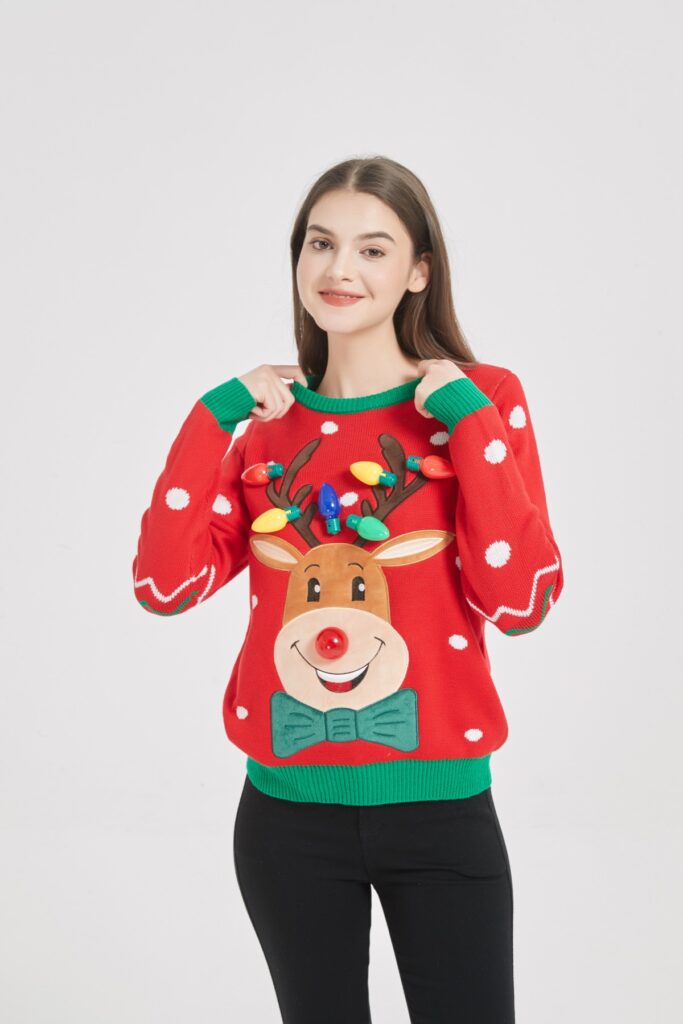
A light-up reindeer may look like a simple holiday novelty. For a buyer developing a custom ugly Christmas sweater, however, the lighting changes the product brief: the knit, raised decoration, bulbs, wiring, power source and care instructions must work together. This QITE project offers a concrete example of how we approached that combination for a customer’s entry into the Christmas sweater market.
The brief: make the reindeer and lights one garment
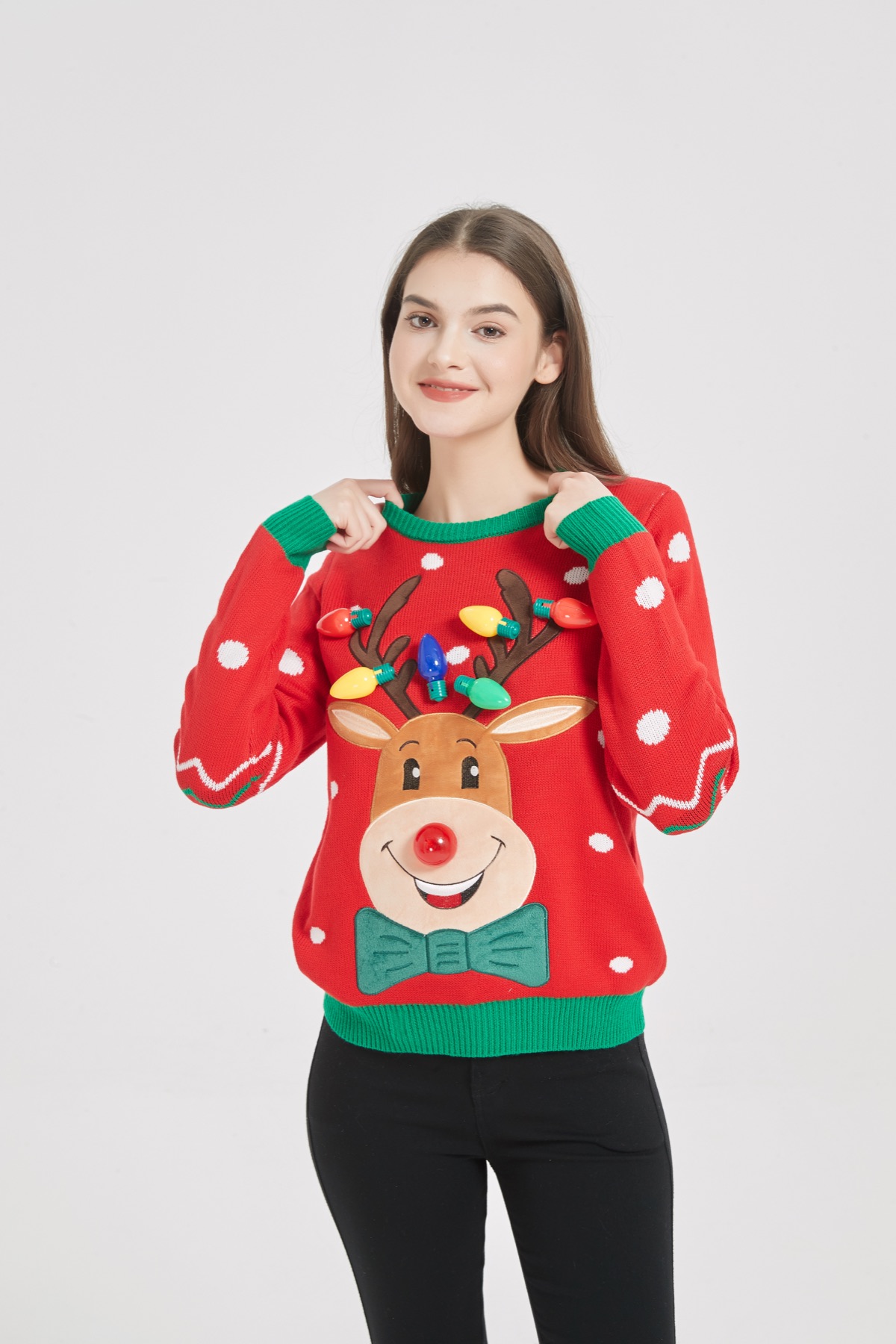
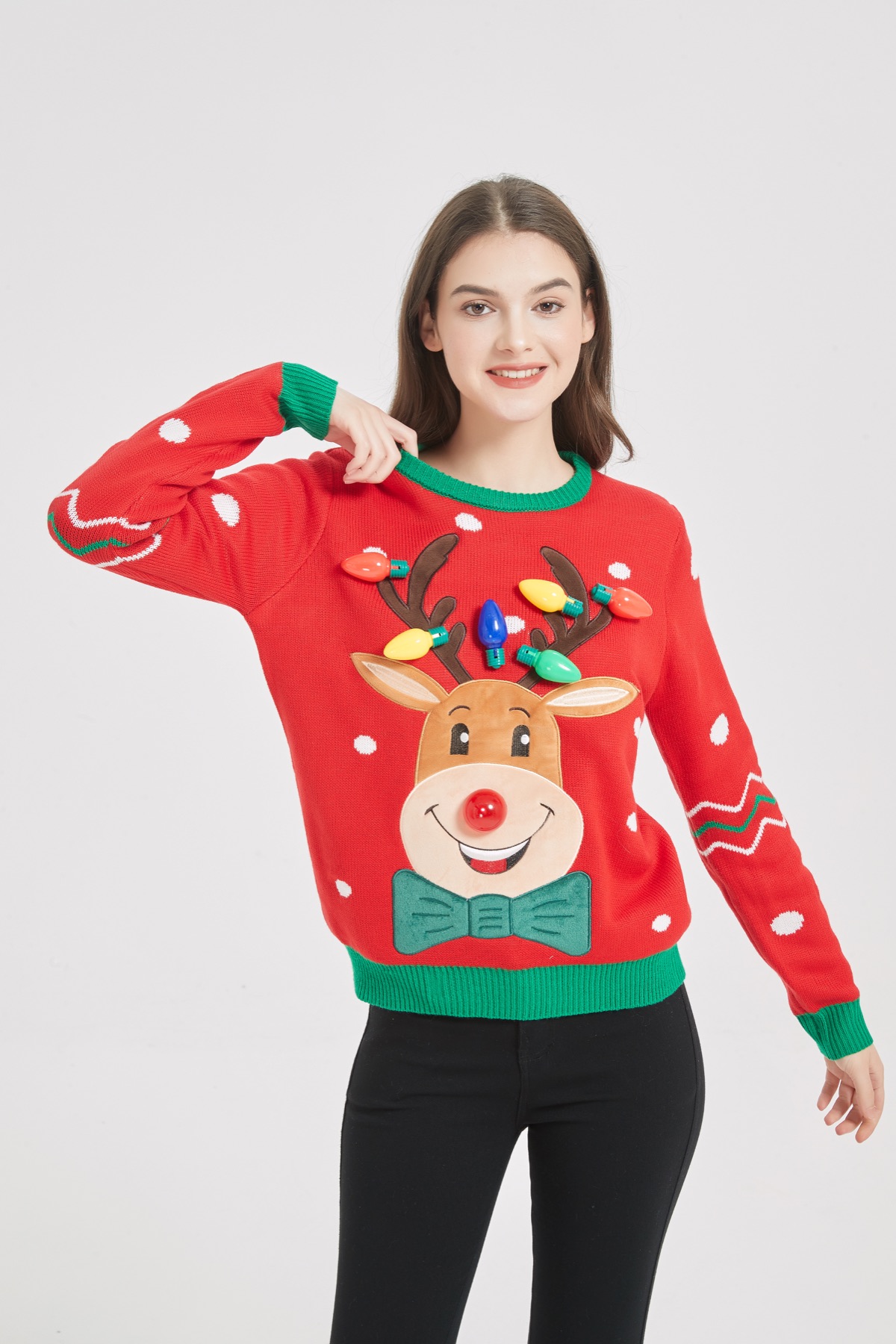
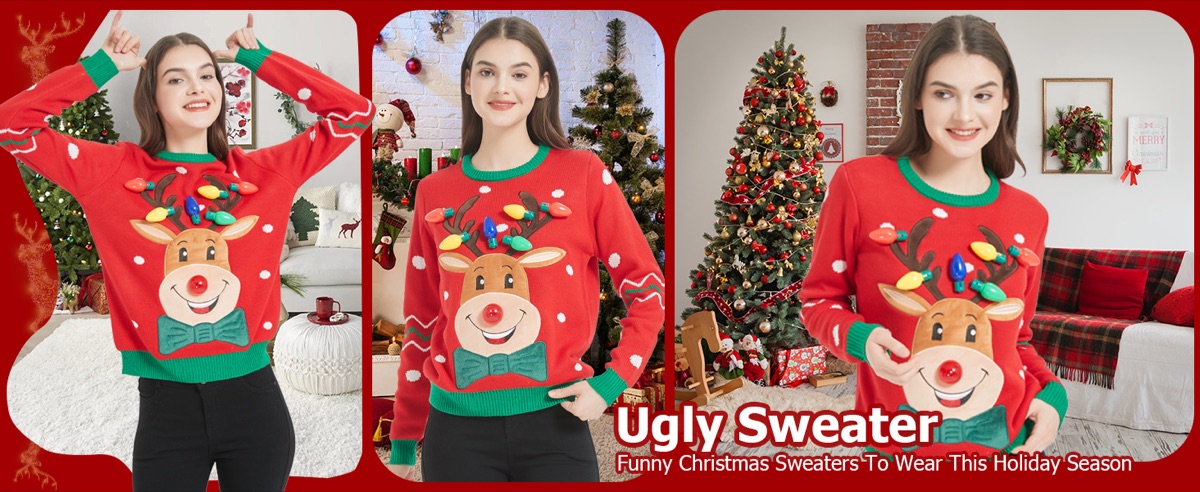
The red knitted body carries a large reindeer face, dimensional antlers, a raised red nose and coloured bulb covers across the upper front. Green ribbing frames the neck, cuffs and hem. For the customer, the three-dimensional lights gave the design a festive presence that a flat graphic alone would not deliver. The customer used this style to enter the Christmas sweater market. It was designed for the kind of novelty-led holiday range familiar to buyers in European and North American markets; we are not claiming a measured sales result or a market-wide ranking for this specific sweater.
This is a knitted sweater with attached components, not a printed sweatshirt. That distinction matters when a buyer compares offers for custom Christmas sweaters or a custom ugly sweater: a price for a flat print does not cover the same construction, handling or review work as a garment with manually fitted lights.
What QITE actually did
QITE sourced the LED bulbs separately for this project. After purchase, our team checked the working condition of each bulb individually before installation. The bulbs were then attached to the sweater by hand, with the switch positioned at the lower hem so the wearer could reach it without placing a control in the central reindeer artwork.
That sequence is important. If a non-working component is discovered only after it has been fixed into a finished knit, the correction is more disruptive. Individual pre-installation checks do not, by themselves, establish electrical, wash or finished-garment safety compliance. Those are separate questions for the complete product and its destination market.
The difficult part is the interface between light set and knit
A knitted body stretches and moves in wear; a bulb assembly does not behave like yarn. The development question is therefore not merely whether a bulb can be attached. A buyer needs to review how the attachment sits against the fabric, whether it pulls or distorts the front, how wiring and the switch are retained, and whether the wearer can operate the control without stressing the knit. Raised antlers and the reindeer appliqué add another layer of material and edge-finish decisions.
For a new light-up Christmas sweater, we would put the following points in the sample review before bulk approval:
- Component map: mark the exact bulb count, colours and positions on a dated front artwork, plus the intended switch location.
- Attachment review: inspect the front and reverse at each light position, including the knit’s appearance when the sweater is worn and moved.
- Electrical specification: record the power source, battery compartment, wiring route, replacement approach and supplier documentation for the actual light set.
- Care decision: establish whether the electrical assembly is removable, what cleaning method is supportable, and how that instruction will be communicated to the wearer. Do not infer machine-washability from an ordinary sweater sample.
- Finished-product check: agree what must be inspected after assembly, not only which loose bulbs passed the initial check.
Battery details cannot be left as an afterthought. For example, if a U.S.-bound design uses button or coin batteries, the U.S. Consumer Product Safety Commission’s button-cell guidance identifies product and packaging requirements that need a product-specific review. This article does not state that the pictured sweater uses that battery type, or that it has passed any particular regulatory test. The applicable requirements depend on the final electrical design, intended users and sales markets.
What to approve before repeating this idea
A buyer can use this case as a starting point, but should not approve another order from the photographs alone. Ask for a physical sample that records the bulb set and artwork version, shows the inside as well as the front, and identifies the switch and power arrangement. Confirm that the reindeer remains legible and comfortable when the garment is worn, and that the raised parts and light positions are acceptable across the intended size range.
If the project includes more than one colourway, size group or retail market, identify which changes require a fresh sample or safety review. A children’s version, for instance, should never inherit approval from an adult novelty sweater without separate assessment. Our broader Christmas sweater sample-approval checklist covers the release record; the specific extra work here is documenting the electrical and textile interface.
How to request a similar custom Christmas sweater
Send QITE the artwork or reference sample you are permitted to use, the target size range, destination markets, estimated quantity by style and colour, and the delivery window. For a light-up design, add the desired light positions and behaviour, preferred power arrangement if known, and any retail or care requirements. If these are undecided, mark them as open questions rather than treating a visual reference as a complete specification.
QITE’s custom Christmas sweaters page explains the wider seasonal programme. Our custom sweaters service covers knitted construction beyond this one novelty style, and the QITE homepage introduces our broader production approach. To discuss an LED reindeer design or another interactive holiday knit, contact our team with the component, artwork and market details so we can review feasibility before a quote or sample is treated as final.