Before you send a bulk kids knitwear program out for quotation, put the decisions that change sampling, cost and bulk consistency into one brief. Wholesale and private-label buyers who compare factories on price alone often discover later that the quotes assumed different size grades, yarns, trim reviews or care claims.
This article is that pre-quotation brief for bulk kids knitwear and sweaters. It is written for buyers preparing a wholesale kids knitwear order, not for shoppers choosing a size at checkout. It gathers the assortment, size and grading rules, yarn and care claims, safety and trim checks, wash and appearance standards, and label and packing instructions that should be locked before prices are compared.
QITE already publishes separate guides on kids’ sweater yarn, size grading, wash testing, safety review and the kids sweater tech pack. Those pages remain the detailed methods. This brief does not repeat them. It shows how to record the decisions they produce so two quotations describe the same product.
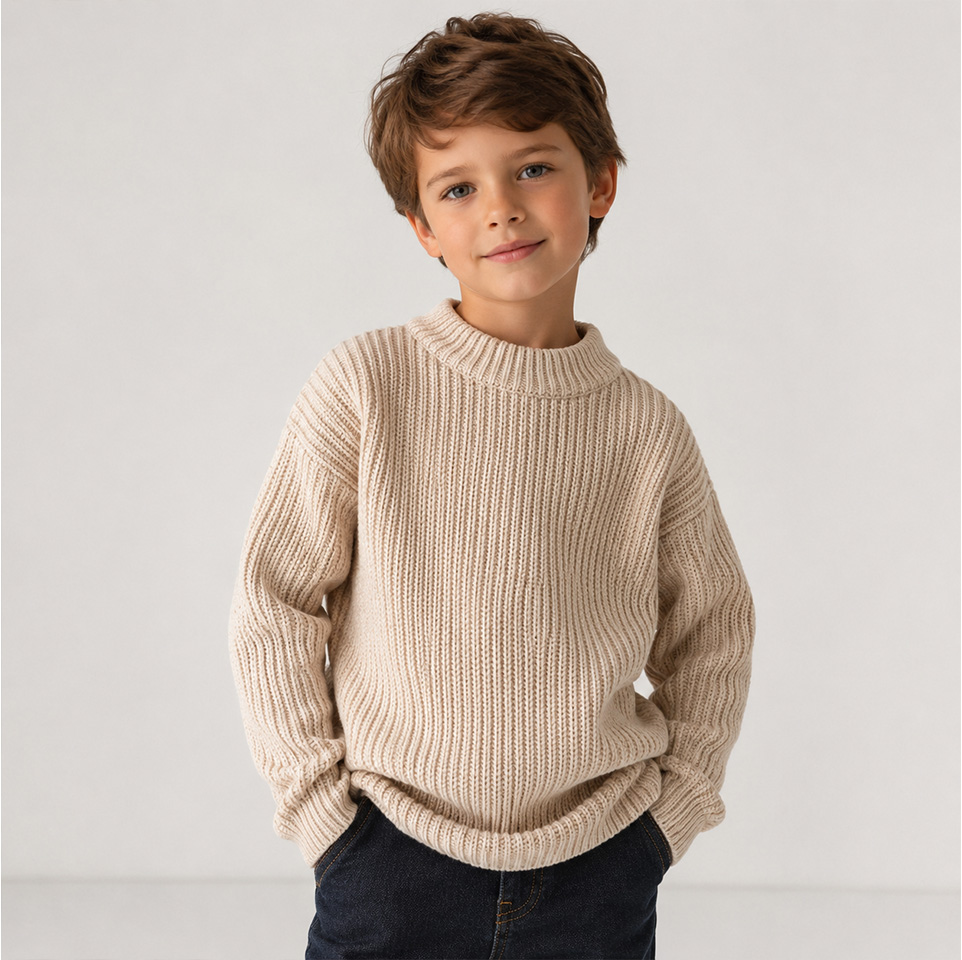
For the available children’s styles and development options, start with QITE’s kids’ knit sweaters page. Style photographs on that page are design references. Yarn composition, gauge, age range, measurements, attached components, MOQ, price and delivery timing still need to be confirmed for each order.
Lock these points before you request a quotation
A factory can price only what has been made visible. If the brief leaves a point open, each supplier will fill the gap differently, and the quotations will not be comparable.
Record the following before you ask for a price:
- Destination market and intended age group (baby, toddler, school-age, older child or teen), written as a production decision rather than a merchandising label alone.
- Product category and end use: pullover, cardigan, vest, coordinated set or selected baby knitwear; everyday school layer, next-to-skin pullover, or occasional festive style.
- Style references: photographs, a physical sample, a sketch, artwork files or a tech pack, with a note on what must be copied and what may be adapted.
- Size range, base size and, if you already have one, the measurement chart the factory should follow.
- Preferred yarn direction or hand feel, and any care claim you intend to put on the label.
- Decorative techniques and trims: jacquard, intarsia, embroidery, appliqué, cables, buttons, zippers, pom-poms, sequins or other attached parts.
- Colourways, estimated quantity by style and colour, and a size ratio.
- Labels, hangtags, packing format and carton assortment, even if artwork files will follow later.
- Testing or inspection requirements you already know the destination market or retailer will ask for.
QITE’s kids’ knit sweaters page lists the minimum information usually needed to begin a review: a product image or sketch, intended age group, required size range, estimated order quantity, preferred yarn or target price, and expected delivery period. Additional measurements, artwork and trim details can be confirmed during sample review.
On that same page, MOQ can start from approximately 500 pieces per style for selected children’s knitwear projects. The final minimum depends on yarn, colour quantity, size range, artwork, trims, labels and packing. Treat that figure as a starting point for discussion, not as a blanket offer for every style.
Do not leave “factory to advise” against a point that will later appear on a care label, a safety review or a packing instruction. A supplier can propose options. The brief should still say which decisions are mandatory and which are open.
The kids’ sweater tech pack guide is the place to turn this list into a file the sample room can follow. This brief is the shorter handover you can use when the tech pack is still being completed, so quotation and sampling start from the same product.
Cost build-ups, sampling steps and production calendars belong in their own records. QITE covers those separately in the OEM kids’ sweater cost breakdown, the sampling guide and the lead-time guide. Do not copy those pages into this brief. Once the product is specified, quantity, yarn availability, gauge, style complexity, packing and the factory schedule can be used to confirm timing.
Set the size range and the grade the factory will knit
An age or height label such as “size 6” or “7–8Y” does not tell a knitting floor the finished chest width, sleeve length or neck opening. Keep three records separate: the target child’s body measurements, the finished garment specification, and the size shown on the retail label. A retail size guide is not automatically a manufacturing specification.
Approve the base size first. Check where the shoulder sits, whether the sleeve allows movement, how the cuff behaves, and whether the hem stays in place when the arms move. Review a cardigan closed as well as open; placket overlap and button placement change the usable fit. Correct the base pattern or knitting specification before you extend the range. A tidy grading spreadsheet will not rescue a base sample with an unresolved armhole or a neck opening that is difficult to dress.
Make every point of measurement repeatable. Name the point on a drawing, state the measuring position, and say whether the value is a flat width or a full circumference. Record the agreed relaxed condition; do not pull a rib band until it reaches the target. Chest, body length, sleeve length, shoulder width, neck opening, and cuff and hem each need their own method. A neck opening also needs a functional dressing check. A relaxed width on a flat garment does not, by itself, show whether the intended wearer can pull a pullover over the head.
Grade by measurement, not by a single enlargement percentage. Chest, length, sleeve and neck do not have to increase by the same amount. If the range crosses a change in body proportion or garment construction — for example, from toddler into school-age — mark that transition and review it. Distinguish the grade rule (the target difference between sizes) from the tolerance (the allowed variation around one size’s target). A tolerance should not be used to excuse an incorrect size progression.
Check the ends of the range, not only the base size. Place samples side by side and look at body-to-sleeve balance, rib depth, shoulder progression and artwork placement. A motif that sits well on the base size may need a planned resize rather than being squeezed between the armholes on the smallest size. A cardigan’s button count or spacing may need a planned change rather than a mechanically stretched placket.
QITE’s kids’ sweater size grading guide explains how to write those rules, measure consistently and approve a size set. Use that guide for the method. In this brief, attach the dated size table, the points-of-measurement drawing, the base size, the sizes that will be physically reviewed, and the measurement condition (before finishing, after finishing, or after the agreed care procedure).
Match yarn, gauge and care claims to how the sweater will be worn
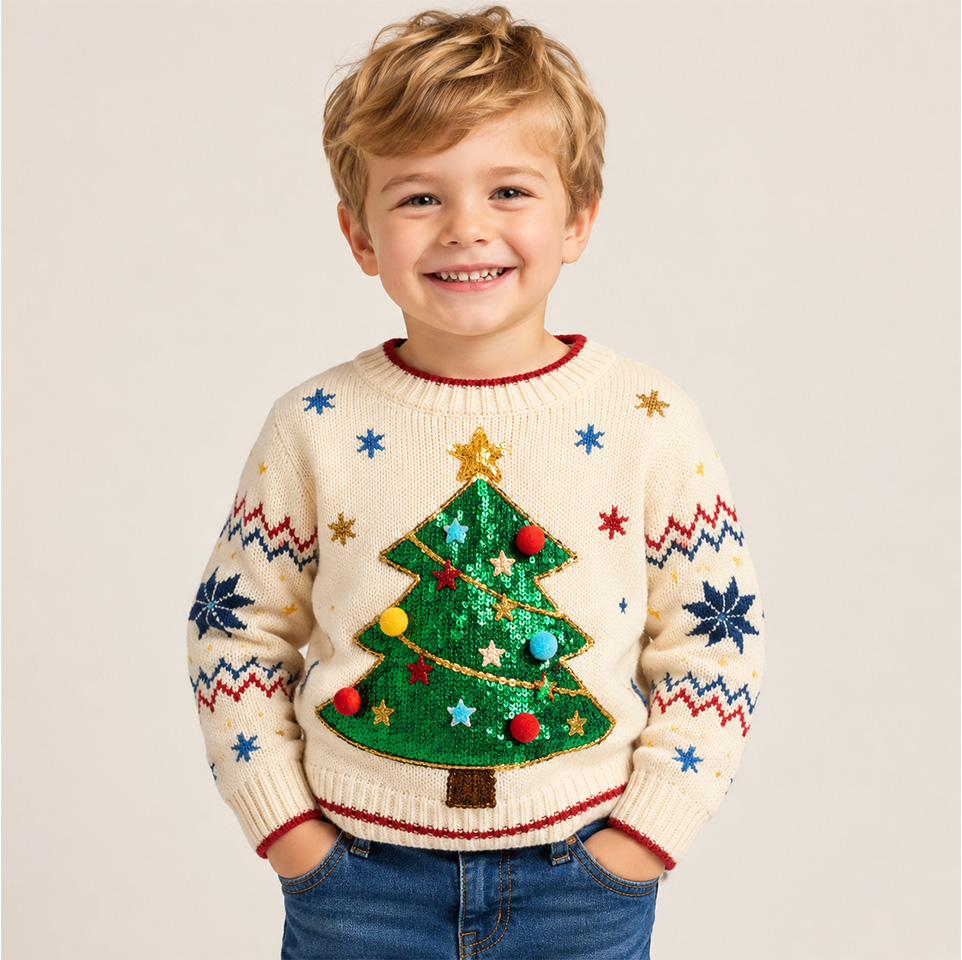
Start with how the child will wear the garment, not with a fashionable fibre name. A cardigan worn over a school shirt, a pullover worn against the neck, and an occasional textured festive style can justify different yarns, gauges and care claims. Write that use in the brief so a yarn proposal can be judged against it.
Compare finished fabrics, not fibre names alone. Cotton, acrylic, wool and blends describe composition choices. They do not, by themselves, establish comfort at the neck, shape retention or tolerance for the intended care. QITE’s kids’ sweater yarn guide sets out how to shortlist yarn by use, check contact points on the inside of the garment, and treat care convenience as an early requirement. The custom sweater yarn and gauge guide covers weight, structure and hand feel for knitted garments more generally. Use those pages for the selection method. In this brief, record the named yarn article, fibre composition, colour standard, target hand feel, gauge direction and any documentation you will rely on.
QITE’s children’s program supports 1GG–16GG development with STOLL computerized flat knitting, from chunky winter styles through commercial mid-gauge products to finer seasonal layers. Gauge is a capability range, not a recommendation for every kids’ style. The right gauge depends on the yarn, the stitch structure and the intended look and weight.
If the product will carry a specific care claim, say so before the yarn is shortlisted. A convenient “machine wash” line cannot be added later to a fabric that was never developed for that routine. A yarn-level care note also does not automatically establish the behaviour of a finished sweater with seams, buttons, embroidery and labels.
Where certification is part of the buying requirement, ask for the actual document and check the holder, article description, scope and validity. Do not turn a yarn or component certificate into a claim that the completed sweater is certified. QITE’s yarn guide is a documentation check; it does not state that QITE or any pictured style holds a particular certificate.
Keep comfort claims inside the evidence you have. A soft first impression is not a medical or “itch-free for every child” promise. If the yarn, finish or supplier changes after approval, the previous choice should not be inherited automatically.
Attach the safety and trim checks to the order
For children’s knitwear, trims and decorations are part of the order, not a later styling choice. The intended age group should be written first, because a trim that is acceptable on an older child’s sweater may not be appropriate on a toddler style.
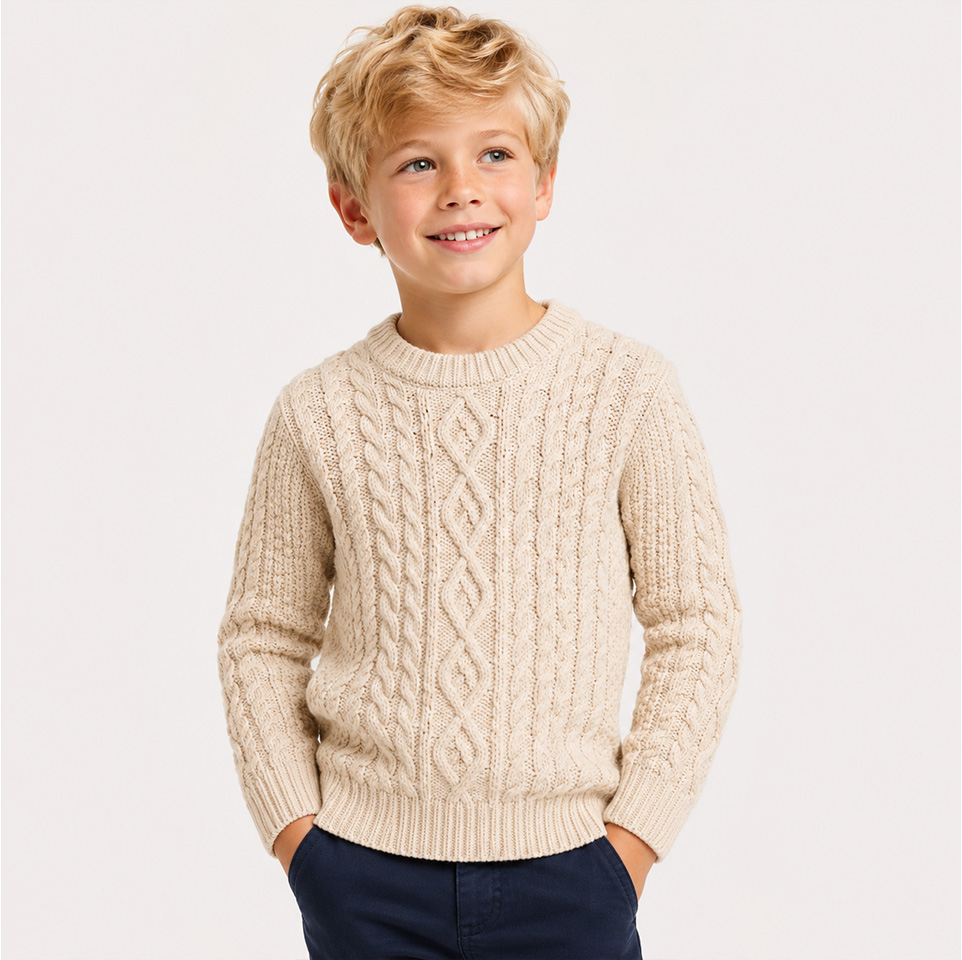
QITE’s kids’ collection and development notes commonly involve buttons, zippers, cords, appliqué, pom-poms, sequins, patches and other attached parts, as well as embroidery and character motifs. For each item, the brief should name the component, the attachment method, the position, the approved source if you have one, and the check that must be completed on the sample and in bulk.
Review, at least:
- Buttons, snaps and zipper pullers: size, edge finish, attachment security, wash durability and comfort at the neck or placket.
- Appliqué, badges, embroidery backing, sequins, beads and pom-poms: attachment method, edge finish, age suitability and appearance after the agreed care procedure.
- Cords, ties, loops and free ends: whether they are present at all, and whether they are appropriate for the garment category, age group and destination market.
- Metal components: type, location, and whether needle or metal detection is required before packing.
Drawstring rules are specific. They should not be summarised as a blanket ban on every children’s sweater. For the U.S. market, the U.S. Consumer Product Safety Commission has determined that hood and neck drawstrings on children’s upper outerwear in sizes 2T to 12, or the equivalent, present a strangulation hazard that is a substantial product hazard. Waist and bottom drawstrings on children’s upper outerwear in sizes 2T to 16, or the equivalent, are also treated as a substantial product hazard unless they meet the stated length and construction limits, including a 3-inch limit outside the channel when the garment is expanded to its fullest width, no toggles, knots or other attachments at the free ends, and bar tacking where the drawstring is one continuous string. See the CPSC’s guidance, Drawstrings in Children’s Upper Outerwear (reviewed 28 November 2026). That determination applies to children’s upper outerwear as CPSC uses the term. Whether a particular knitted style falls in that category is a classification question for the buyer’s compliance team. This article is sourcing guidance, not legal advice.
The same caution applies to product classification more broadly. Under CPSC guidance, a “children’s product” is a consumer product designed or intended primarily for children 12 years of age or younger. Children’s products are subject to applicable children’s product safety rules; where those rules apply, third-party testing and a written Children’s Product Certificate may be required. See Children’s Products on CPSC.gov (reviewed 28 November 2026). Requirements vary by destination market, age group, product type and final design. Confirm the applicable scope with a qualified testing or compliance professional before the order is released.
QITE can include needle and metal-detection control where it is required by the confirmed product category, trim specification and order requirements. That should be written into the brief before bulk production, not added at final packing. Use the OEM kids’ sweater safety, sizing and MOQ guide and the children’s sweater OEM production article on fit, trims and safety sign-off for the detailed review points. This brief should attach the trim list, the age-group decision, the destination-market checks requested, and the metal-detection requirement where it applies.
Define the wash, shrinkage and appearance standard bulk must meet
A sample that looks correct when it leaves the factory can still change after washing because of yarn behaviour, stitch structure, finishing or a care instruction that does not match the test. For a bulk kids knitwear order, agree the wash standard before you approve production, and test a production-representative sample — the confirmed yarn, construction, trims and intended care method.
Define the test conditions first: sample identity, wash method, temperature, detergent, drying method, number of cycles, conditioning time and the acceptance limits you will use. Then measure the same points before and after washing, using the same method, and calculate dimensional change for each point separately. Body width, body length and sleeve length can move by different amounts. Shape retention is part of the same review: twisting, neck recovery, cuff and hem behaviour, surface change, colour appearance, trim security and label condition.
There is no single shrinkage or appearance limit that fits every knitted children’s sweater. The buyer, product category, yarn and target market should set the acceptance criteria. An illustrative calculation belongs in the method guide, not in this brief as a pass mark.
The care instruction on the label should match the method that was tested. Testing one routine and labelling another produces a claim the sample never supported. For textile wearing apparel sold in the United States, 16 CFR Part 423 requires manufacturers and importers — including a person or organization that directs or controls manufacture or importation — to provide regular care instructions, and to attach care labels so they can be seen or easily found when the product is offered for sale. See 16 CFR Part 423 (reviewed 28 November 2026). Other markets have their own labelling rules. Confirm the current text and the evidence required for your care claim with your compliance team. QITE’s kids’ custom sweaters wash-testing guide explains how to record the procedure, the measurements and the appearance result. Use that guide for the method. In this brief, attach the agreed care direction, the test method, the sample identity, the acceptance limits and the rule for retesting if yarn, gauge, finishing, construction or care method changes.
A development wash review does not replace a retailer’s required laboratory test. A good sample result also does not remove the need for bulk control: the approved yarn, gauge, construction and finishing process should be the ones used in production.
Specify labels, packing and carton marks for the children’s program
Labels and packing are part of the product, not an afterthought for the shipping week. If they are missing from the brief, quotations may omit them, or bulk cartons may arrive in a format the warehouse cannot receive.
For a private-label children’s program, specify, as far as the files are ready:
- Main or neck label, size label, fibre-content label and care label.
- Country-of-origin information, where it is required for the destination market.
- Hangtags, barcode stickers and any retailer ticketing.
- Individual polybag or other unit packing, including any warning or packaging instruction the destination market or retailer requires.
- Folding method, carton assortment or size ratio, and carton marks (style, colour, size breakdown, quantity, purchase order, destination and any other marks the consignee needs).
QITE’s kids’ program can support main labels, care labels, size labels, hangtags, barcode stickers, individual bags, carton assortments and buyer-specific packing instructions, as described on the kids’ knit sweaters page. The kids’ sweater tech pack guide is the place to put the artwork and packing page into the production file.
Fibre-content, origin and care-label rules are market-specific. For U.S.-bound textile apparel, start from the care-label requirements in 16 CFR Part 423 cited above, and confirm fibre-content and origin obligations with your own compliance team. Do not copy another market’s label pack onto a new destination without review. Polybag warnings and carton marks should follow the buyer’s written instruction, not a generic export default.
If only draft packing notes are available at quotation, say so, and state when final artwork will be issued. A quotation that assumes unbranded polybags is not the same product as a retailer-ready packed unit.
Keep a confirmation record — and know what this brief cannot replace
Write the brief so a later sample comment or bulk inspection can still be traced to it. A useful confirmation record names the product and the decision, rather than stating that “everything looks fine.”
| Record field | What to attach |
|---|---|
| Product identity | Style, colourway, yarn article, gauge, stitch revision and destination market |
| Assortment and quantity | Size range, size ratio, colourways and estimated units, with any open quantity clearly marked |
| Size evidence | Dated measurement table, points-of-measurement drawing, base size, sizes reviewed and fit comments |
| Yarn and care | Named yarn, composition, colour standard, intended care direction and any certificate scope still to be verified |
| Safety and trims | Trim list, attachment methods, age-group decision, requested tests and metal-detection requirement where applicable |
| Wash and appearance | Test method, sample identity, acceptance limits, results or a clearly marked pending check |
| Labels and packing | Label list, packing format, carton assortment and marks, or the date final artwork is due |
| Decision | Approved, rejected or conditionally approved, with the scope of the approval stated |
| Follow-up | Corrections, the person responsible, and whether a new sample is required |
If only the base-size fit is approved, say so. Do not let that become an implied approval of the full size range, wash performance, all trims or the packing pack.
This brief cannot replace:
- A complete, version-controlled kids sweater tech pack.
- The detailed methods in the yarn, grading, wash-testing and safety guides.
- Destination-market legal advice, laboratory testing, or a Children’s Product Certificate or other conformity document where one is required.
- Bulk quality-control checks, or a separate discussion of cost and delivery once the specification is stable.
When the brief is ready, send it with the reference images or measurement files through QITE’s kids’ knit sweaters inquiry or the contact page. The aim is a quotation and a first sample that can be judged against a written standard, not against an unstated assumption.