
Two factories can quote different prices for what appears to be the same custom sweater—even when both use the same yarn. One reason is that the quotation may cover different amounts of finishing, inspection, testing and packing work. The lower number is useful only if the buyer understands what it leaves out.
At QITE, we see this most clearly in the details that are easy to miss in a product photo: loose thread ends on a care label, an untidy linked seam inside the garment, or a sweater pressed to size without a representative wash check. None of these is a reason to assume that every low-priced factory is careless. They are reasons to compare the same work scope before choosing a supplier.
Thread trimming: a small operation repeated on every garment
Loose ends may appear on the body, around the neck and care labels, at button attachments and near decorative details. Removing them cleanly takes handling time on each sweater. If a quote excludes this step, the garment may still be wearable, but the buyer receives a different level of finish—and may need to pay for rework before retail packing.
Specify that visible loose ends are trimmed, label and button attachments are tidy, and the garment is checked on both the outside and inside. Ask how a loose end is secured before it is cut: cutting a structural yarn tail flush can create a weak point. An approved sample should show the finish standard the bulk order must match.
Linking and seam finishing: the hidden side of the quote
Many knitted panels are joined by linking. After the join, surplus yarn and join ends need to be dealt with carefully. A quick external check may not reveal a loose or bulky seam on the inside. The extra minutes spent securing ends, reviewing seam tension and removing unnecessary tails add labour cost, but they also affect comfort and whether the seam holds up in wear.
For a comparable quotation, ask the factory to include an inside-out seam review at the neckline, armhole, shoulder and side seams. Mark any accepted seam appearance or tolerance on the sample. This is more useful than an instruction such as “good workmanship,” which two suppliers may interpret differently.
Inspection coverage: define the checks and who performs them
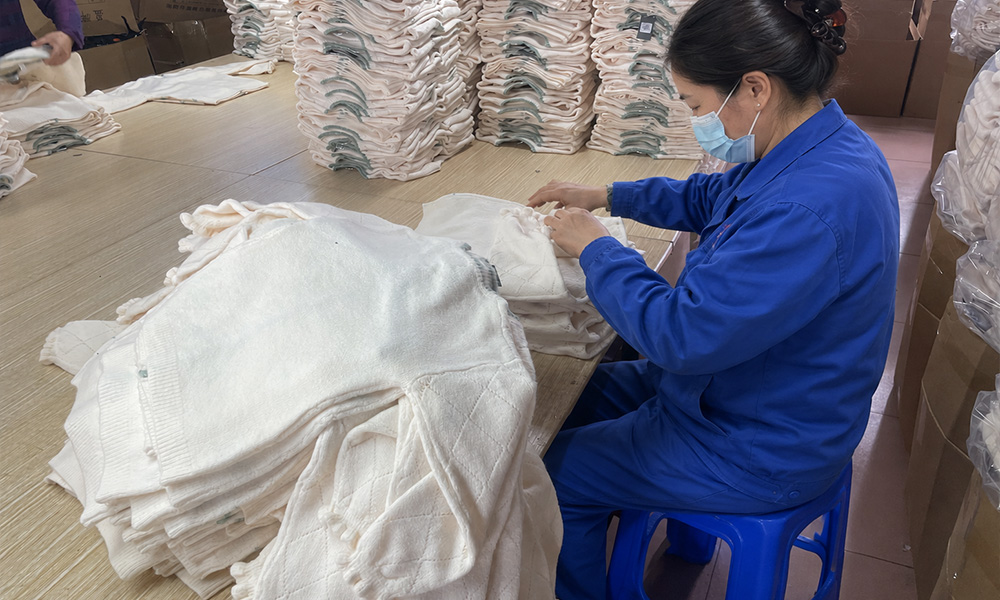
A buyer should distinguish in-line review, piece-by-piece visual inspection, measurement checks and final shipment inspection. They do different jobs. QITE currently has four quality-inspection teams and performs a visual check on each sweater before packing, according to our production team. That does not mean every laboratory test or dimensional measurement is performed on every piece; those requirements should be specified separately.
For example, a light-table or transmitted-light check can help reveal holes or dropped stitches in some constructions. Needle detection can be added when the buyer’s programme requires it, with the method and rejection procedure agreed in advance. A needle detector is aimed at broken ferrous needle fragments; it is not a promise that every possible metal contaminant or trim will be found. Equipment maker HASHIMA explains the limits of needle detection.
A price comparison should state whether these checks are included, whether the result is recorded, and who pays for reinspection after a failure. Otherwise, one quote may include work that another places outside the unit price.
Washing, drying and pressing: do not confuse appearance with stability
Pressing can make a newly finished sweater look neat and meet a target measurement at the factory. It does not by itself show how the garment will behave after the customer follows the care label. Yarn, knit structure, washing method and drying method can all change the finished dimensions. A garment can shrink, grow or distort; a severe change is possible but should not be assumed for every unwashed sweater.
Before comparing quotes, specify whether the order includes a garment-wash or other finishing process, and separately specify a representative wash-and-dry dimensional test using the intended care method. Record measurements before and after, plus the accepted change. AATCC TM150-2025 describes a method for measuring garment dimensional change after home laundering; the applicable test and acceptance limit still need buyer approval.
QITE’s production team says that each bulk sweater goes through washing and drying before final pressing, with the process adjusted to the yarn and style. That production step is distinct from a representative dimensional-change test: the latter measures and records what happens under the agreed care method. If one supplier includes both appropriate finishing and a wash test while another only presses the garment, the prices are not comparable. For more on measurement after care, see our wash-testing guide.
Labels and packaging: supply-chain savings are not automatic
Cartons, polybags, hangtags and neck or care labels all add cost. QITE’s established trim-sourcing relationships can sometimes reduce that combined cost. In some comparable programmes, our team has seen a difference approaching US$1 per sweater, but this is not a standard saving or a guaranteed discount: quantity, material, print specification, country requirements and packaging design change the result.
A buyer should compare like for like: label material and dimensions, print colours, individual bag thickness, carton strength, barcode work and packing method. A cheaper carton or lighter label may not be a saving if it fails the retailer’s specification. Our packaging guide
FOB and DDP: compare the same delivery point
A factory-gate or FOB quote should not be compared directly with a DDP destination quote. They include different transport, customs, duty and risk obligations. The ICC Incoterms® 2020 checklist shows why a named place and the correct rule matter. For containerized or multimodal shipments, the buyer should also check whether FCA is more suitable than FOB.
Distance to the export port and freight-forwarder arrangements can affect the inland leg, but they do not make one supplier universally cheaper. Ask each factory to quote the same Incoterms rule, named place, quantity, carton specification and delivery date. Only then compare the garment and inspection costs separately from logistics.
A quotation request that makes the difference visible
When you send the same sweater specification to two factories, ask both to confirm these six lines in writing:
- Thread trimming and inside/outside seam-finishing standard.
- In-line, piece-by-piece visual, measurement and final inspection scope.
- Whether needle detection is required, and the agreed method and records.
- Garment finishing process, wash-test method and accepted dimensional change.
- Exactly which labels, bags, hangtags and cartons are included.
- Incoterms rule, named place, transport scope and delivery date.
The result is not necessarily a higher quote. It is a quote you can understand. If the lower-priced supplier can meet the same approved finish and inspection requirements, that is a genuine commercial advantage; if a step is excluded, you can price the difference before placing the order.
For a wider view of yarn, gauge and construction costs, read our custom sweater manufacturing cost guide. You can also review QITE’s custom sweater service and homepage. To compare a specific production brief, send us your tech pack and identify which inspection and delivery requirements must be included in the price.