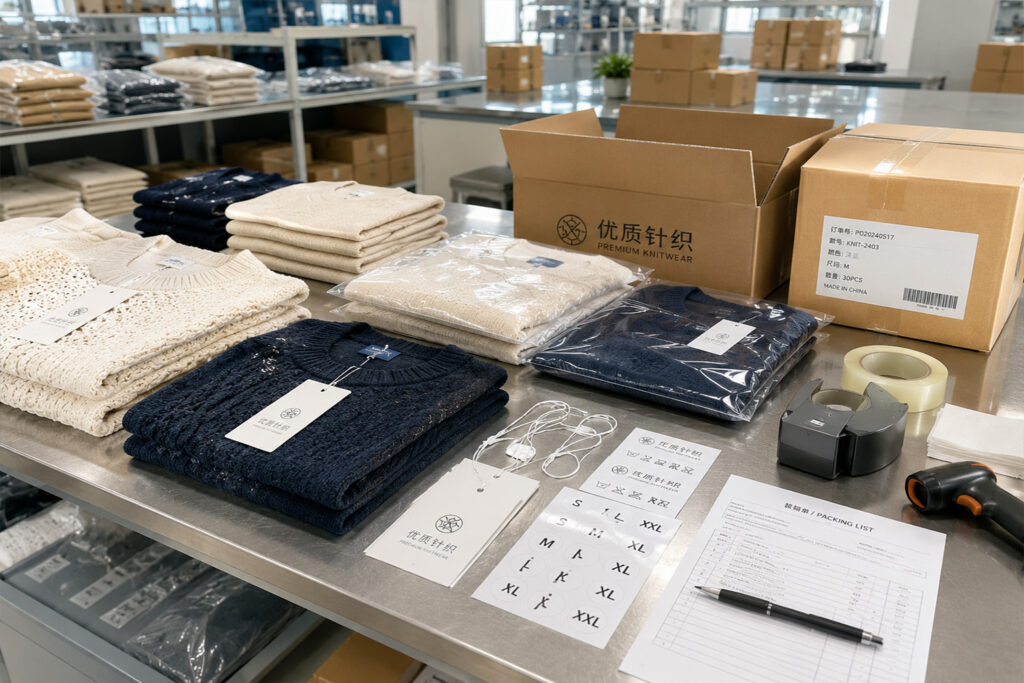
The Christmas sweater is finished, but the gift box will not close without pressing on the decoration. The smaller sizes fit; the largest does not. Meanwhile, the barcode on the sleeve wrap identifies the wrong colour. None of these problems is solved by approving another front-view garment photograph.
Custom Christmas sweater packaging needs its own physical trial. This guide focuses on the handover from an accepted garment to a retail-ready packed unit: presentation, protection, identification and carton contents. For the garment itself, start with QITE’s custom Christmas sweater service.
Separate presentation packaging from transport protection
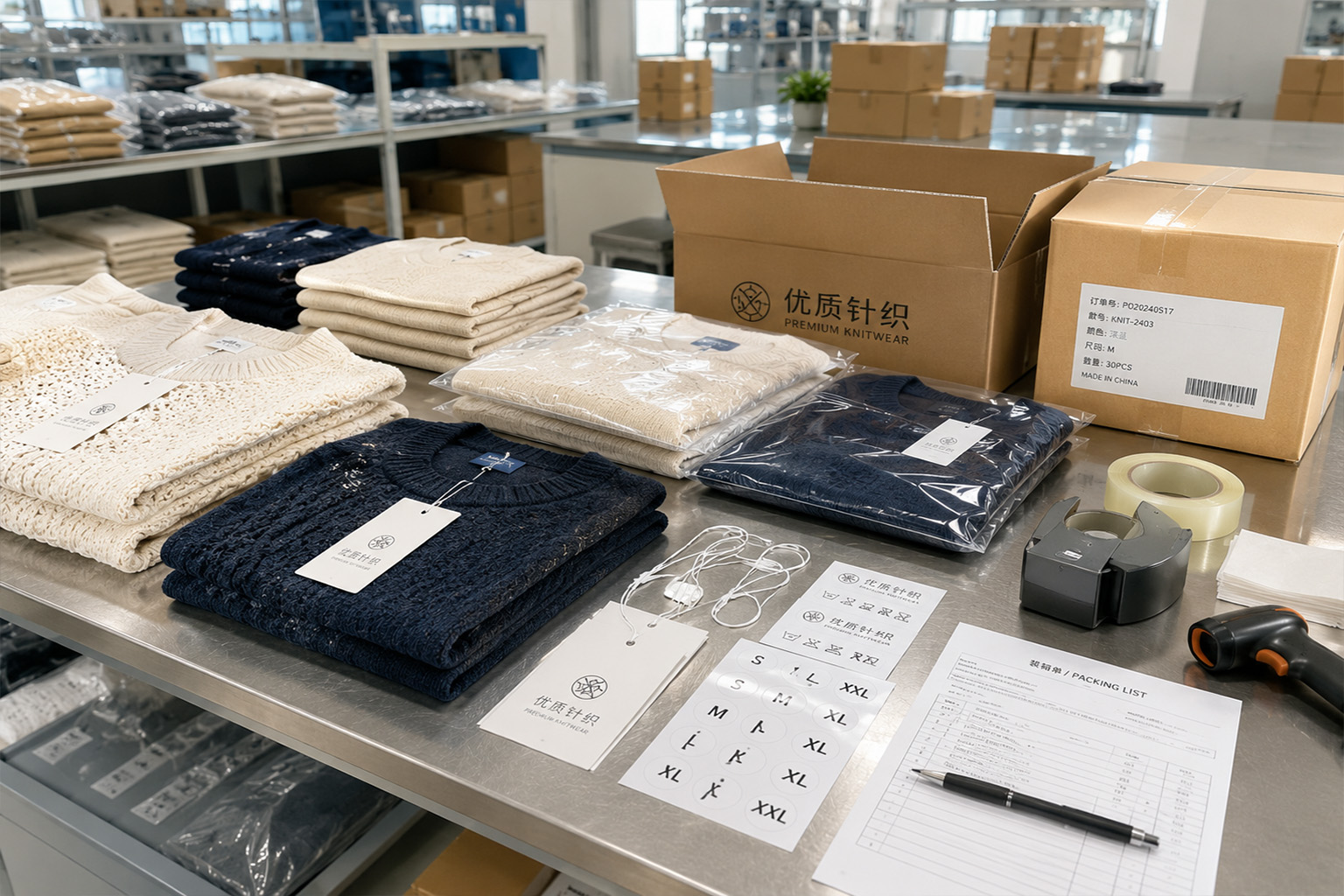
Name the layers of the pack. A hangtag, individual protective bag, paper wrap, gift box and shipping carton perform different jobs. A beautiful retail box should not automatically be treated as a parcel-ready outer package, and an export carton does not replace the consumer-facing presentation.
Tell the supplier how the goods will reach the customer. Will a wholesaler unpack and hang the sweaters, a retailer sell them in gift boxes, or a fulfilment team add the final mailing package? Confirm which operation is included in the factory quotation and which remains with the buyer.
| Packing route | Decision to make before ordering materials |
|---|---|
| Wholesale delivery for unpacking | What individual protection, size visibility and carton assortment does receiving require? |
| Shelf-ready gift box | Does the complete garment fit, remain identifiable and present correctly when opened? |
| Box supplied separately | Who assembles and fills it, and how are garment and box quantities reconciled? |
| Direct-to-consumer fulfilment | What does the fulfilment provider require in addition to the retail pack? |
Specify the intended route rather than ordering every layer “to be safe.” Extra packaging can add work and volume without resolving the actual receiving or protection requirement.

Trial the fold with the real garment
Use a production-representative sweater with the intended decoration and trims. State the fold direction, where the sleeves sit and which part of the motif should appear when the pack is opened. Photograph the sequence, not just the closed box.
Try the relevant size extremes and materially different constructions. A box selected around a plain middle-size sample may not suit a larger cable sweater or a style with attached components. Do not assume the same nominal garment size means the same folded volume.
Look for pressure on raised embroidery, sequins, pom-poms, appliqué edges and rigid components. If the fold places a hard detail against the knitted surface, ask for a packing arrangement that addresses that contact. Any insert or protective layer should be trialled with the actual product rather than specified from a flat artwork file.
The Christmas sweater decoration guide helps identify the construction that needs protection. This is not another decoration approval: the question is what happens when the accepted design is folded, handled and packed.
Size a gift box from the filled pack
Request the usable internal dimensions and a physical box sample. External dimensions, a drawing of the lid or a supplier’s description of a “standard sweater box” are not enough to establish fit.
Fill the box using the proposed fold and all intended inserts, tags and tissue. Check that it closes as intended without forcing the lid, and that the garment does not shift into an unattractive or damaging position during the agreed handling trial. If the box is a retail presentation item, review how it looks when reopened too.
An illustrative decision, not a QITE customer case, is a boxed festive style with a raised front motif. The smallest size fits neatly, while the largest presses against the lid. Possible routes include revising the fold, changing the box or separating the packaging specification by size group. The buyer and supplier should compare actual filled samples before selecting a route; no universal box dimension follows from the garment’s chest size.
If packaging changes the packed volume, ask the shipping or fulfilment provider to review the consequences. Do not approve a larger box on appearance alone and assume the previous carton plan remains valid.

Keep garment labels, gift artwork and selling-unit identity connected
Create one packing record for each relevant style, colour, size and packaging version. Identify the garment label files, hangtag, individual pack, barcode file and any gift insert that belong together.
Avoid copying last season’s gift artwork without reviewing its wording and product claims. A new design, changed composition or revised care instruction can make an old insert incorrect even when the brand logo has not changed. Have the applicable label content and market requirements reviewed for the destination; this article does not supply universal legal label wording.
The existing private-label labels and packaging guide covers the broader components. The practical addition here is the relationship between them: the information visible outside a closed gift pack must correspond to the garment inside it.
Check the barcode on the final material and position
Use the buyer’s approved identification data and the receiving retailer’s requirements. Check the number or item mapping as well as the printed symbol. A code that scans but identifies another size is still wrong.
GS1 UK’s barcode-placement guidance advises keeping symbols and their quiet zones away from folds, seams, edges and other interfering features. For a festive pack, that means checking the actual position relative to the box closure, sleeve overlap or decorative artwork rather than approving a code on a separate white proof sheet.
Request the required barcode verification on the final print and packaging specification. A quick phone scan may be a useful additional handling check, but should not be represented as the retailer’s formal acceptance procedure. If there are several identifiers on the packed unit, establish what each is for and how receiving staff should use them.
Reconcile garments, boxes and cartons before release
For an employee event, the receiving team may need cartons sorted by office or handout group rather than retail SKU alone. The company-event order guide connects that packing decision to the final size and destination matrix.
Give the packing team an assortment sheet that can be checked independently of the design files. State whether cartons contain a single variant, a defined size assortment or another buyer-approved mix. Agree how partial cartons and changed quantities will be marked.
| Packed-unit check | What to compare |
|---|---|
| Garment identity | Style, colour and size against the order and pack label |
| Decoration protection | Accepted fold and protective arrangement against the physical unit |
| Retail presentation | Correct box or wrap version, insert and opening presentation |
| Identification | Approved code mapping, visible size and required print verification |
| Carton contents | Actual count and assortment against the carton marking and packing list |
| Variations | Any approved change, shortage or separately supplied packaging clearly recorded |
Where gift boxes ship separately, count them as a separate packing item. Do not let a garment total serve as evidence that the correct number of boxes, sleeves or inserts has been supplied.
Before sealing, confirm the agreed garment condition and packing procedure with the production team. Do not improvise extra chemical treatments, moisture-control products or compression merely to fit an existing carton. Where the product or route needs specific protection, establish and assess that requirement with the appropriate supplier or logistics provider.

Retain one complete packed reference
An accepted sweater without its packaging cannot show the packing team the approved fold, tag position or box contents. Keep a complete identified packed reference, supported by photographs and the current packing record.
State what the review covers and what it does not. Accepting the gift-box appearance does not demonstrate transit performance. A packaging trial does not authorise an unapproved garment or artwork revision. Use the Christmas sample-approval checklist to keep those release boundaries explicit.
Carry the accepted packing requirements into the knitwear quality-control plan. If the box, fold or decoration changes later, identify which packing checks need repeating instead of quietly substituting the new arrangement.
Preparing a packing brief for QITE
QITE Garments builds its offering on sweater and knitwear production and can review buyer-defined labels and packing within its custom sweater development service. Availability and suitability of a particular gift-box or protective arrangement should be confirmed for the project, not inferred from a reference picture.
Send QITE the sales route and packing requirements with the garment specification, size range, decoration details and quantity breakdown. The useful outcome is a physical packed unit and a record that receiving staff can follow—not simply attractive packaging artwork that has never held the sweater.