For private-label brands working with an OEM kids’ sweater manufacturer in China, children’s knitwear needs more than attractive colors, soft yarn, and a good fit. Product safety must be planned from the first design brief through sampling, bulk production, metal detection, packing, and shipment.
A knitted sweater, cardigan, vest, dress, or pullover may include buttons, pom-poms, appliqués, decorative cords, zipper pullers, embroidery, metallic yarn, labels, and packaging. Each element can affect the product’s safety profile, testing needs, and suitability for a particular age group.
This OEM kids’ sweater manufacturer guide helps brands develop private-label knitwear with a structured approach to safety, yarn selection, trims, sizing, metal detection, testing, documentation, MOQ planning, and supplier communication.
This article provides general sourcing guidance, not legal advice. Product requirements vary by destination market, intended age group, product category, and final design. Brands and importers should confirm applicable rules with qualified testing and compliance professionals before production.
OEM Kids’ Sweater Safety: Start With the Intended Age Group
The age group is not only a merchandising decision. It influences product design, labeling, testing, and safety expectations.
At the start of development, define whether the garment is intended for:
Babies and infants
Toddlers
Younger children
Older children
Children’s sleepwear
General-use products that may also be worn by children
A style designed for a toddler may require a different risk assessment from a similar-looking sweater for an older child. Small decorative components, long cords, loose attachments, and openings around the neck or hood should all be reviewed in relation to the product’s intended user.
For the U.S. market, products designed or intended primarily for children aged 12 or younger are generally treated as children’s products under Consumer Product Safety Commission guidance. The importer, manufacturer, or private labeler is responsible for identifying which requirements apply to the final product.
1. Yarn Safety and Performance Checklist
Softness matters in children’s knitwear, but it is only one part of yarn selection. The yarn should also be appropriate for the garment’s use, washing expectations, and destination-market requirements.
Before sampling, ask the supplier to confirm:
Exact fiber composition
Yarn count, thickness, and proposed gauge
Fiber source and yarn mill, where available
Color options and dye-lot control
Whether the yarn contains metallic fibers, brushed fibers, or decorative effects
Wash-care recommendation
Pilling and shape-retention expectations
Available chemical-compliance or restricted-substance documentation
Whether the sample yarn and bulk yarn will come from the same approved source
For baby and toddler knitwear, brands often prioritize a soft hand feel, low irritation risk, stable color, and easy-care performance. Cotton, cotton blends, fine acrylic, wool blends, recycled fibers, and regenerated cellulosic fibers may all be suitable depending on the product concept.
However, a fiber name alone does not confirm safety or quality. Brands should review the finished garment, including dyeing, prints, labels, trims, and applied decoration.
2. Check Buttons, Pom-Poms and Decorative Trims
Children’s knitwear often uses decorative details to create character and retail appeal. Common examples include novelty buttons, pom-poms, bows, appliqués, badges, sequins, beads, tassels, embroidery, and 3D details.
These components should be reviewed for attachment strength, sharp edges, breakage risk, and age suitability.
Before approving a sample, check:
Are buttons securely sewn and reinforced where needed?
Can a pom-pom, badge, or appliqué detach during normal use or washing?
Are beads, sequins, rhinestones, or decorative studs appropriate for the target age?
Do trims have sharp points, rough edges, or exposed backing?
Can a zipper puller or decorative charm become detached?
Are embroidery threads securely finished on the inside of the garment?
Does the garment remain safe after washing and wear testing?
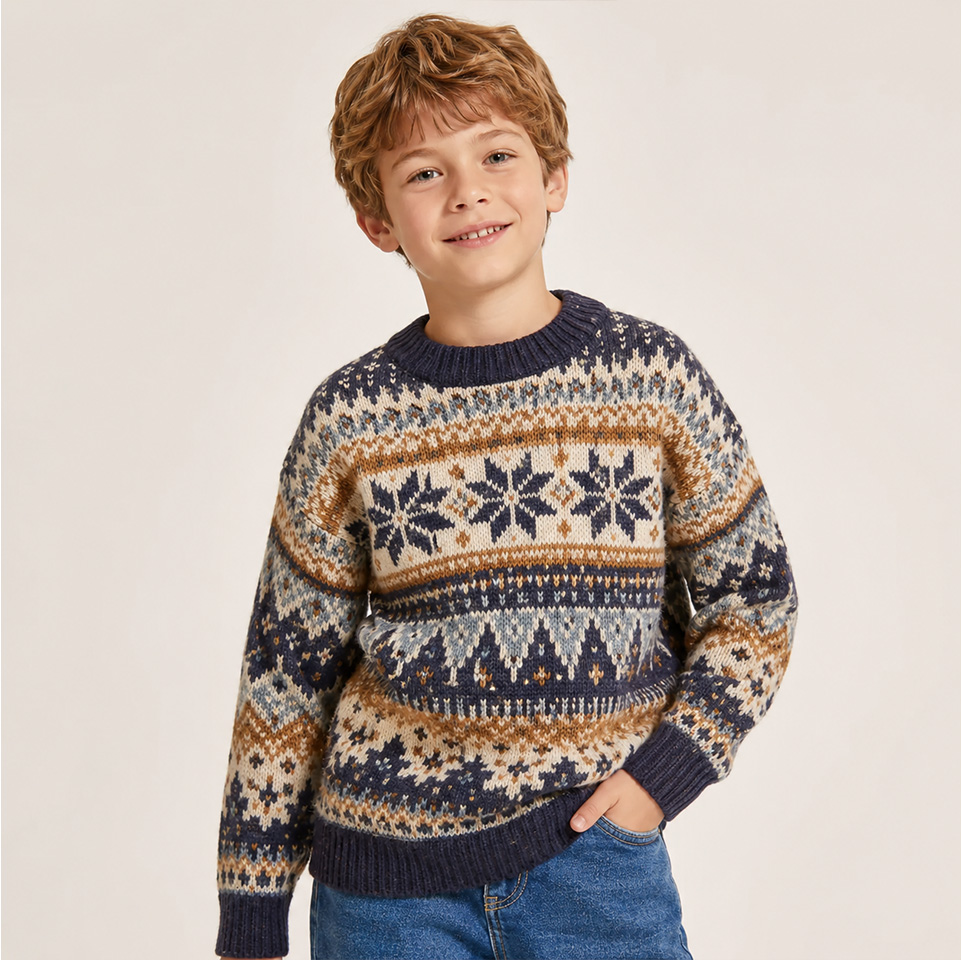
For very young children, simpler designs are often commercially wiser. A clean jacquard motif or securely knitted-in pattern can create a playful look with less attachment risk than multiple loose decorative parts.
3. Avoid Drawstring Risks in Children’s Outerwear
Drawstrings require particular attention in children’s garments. Hood and neck drawstrings can create an entanglement or strangulation hazard in children’s upper outerwear.
For U.S.-bound children’s upper outerwear, CPSC guidance identifies hood and neck drawstrings in sizes 2T to 12 or equivalent as a substantial product hazard. Waist and bottom drawstrings are also subject to specific restrictions in sizes 2T to 16 or equivalent.
For many private-label children’s sweaters, hoodies, and cardigans, the most practical design choice is to avoid functional hood or neck drawstrings altogether.
Consider safer alternatives:
Fixed knitted cords that cannot be pulled through
Decorative imitation ties with no free ends
Elasticated openings
Buttons, snaps, or zippers where suitable
Ribbed necklines and fitted hoods without cords
Do not assume that a drawstring is acceptable simply because it is short or decorative. Share the final sample and intended age range with your compliance partner before bulk production.
4. Confirm Sizing, Fit and Neck Openings
Sizing is a quality issue, but it can also create safety and comfort concerns. A poorly fitted children’s sweater may have an overly tight neck opening, unstable shoulder shape, overly long sleeves, or a body length that affects movement.
Your kids’ knitwear tech pack should include:
Item
What to Specify
Intended age range
For example: 2-3 years, 4-5 years, 6-7 years
Garment measurements
Chest, body length, sleeve length, shoulder, neck opening, hem width
Measurement tolerance
Acceptable variation during bulk production
Fit reference
Relaxed, regular, slim, oversized, or layered fit
Neck construction
Crew neck, V-neck, polo, mock neck, hood, or cardigan opening
Stretch requirements
Rib recovery and opening stretch where relevant
Wash expectation
Whether the garment must retain dimensions after home laundering
A garment should be measured before and after relevant wash testing if the brand has specific shrinkage or dimensional-stability requirements.
For size sets, brands should check that grading is logical. A neckline, sleeve, or body length should not increase mechanically without considering how children move and wear layers.
5. Separate Everyday Knitwear From Sleepwear
Children’s sleepwear may be subject to different requirements from everyday sweaters, cardigans, or fashion knitwear. Do not treat a knitted pajama top, nightdress, or sleepwear set as an ordinary apparel style.
If a garment is intended, marketed, or likely to be sold as sleepwear, discuss the design and applicable flammability requirements with a qualified testing laboratory before sampling. The age range, garment fit, fabric type, labeling, and product presentation can all matter.
For an everyday knitwear program, brands should still consider the general flammability requirements applicable to clothing textiles in the destination market.
6. Build a Market-Specific Testing Plan
Testing should be planned before bulk production, not after the goods are finished. The final test plan depends on the product, target age, sales region, retailer requirements, materials, trims, and claims.
Possible test areas may include:
Fiber-content verification
Colorfastness to washing, rubbing, perspiration, or saliva where relevant
Dimensional stability after washing
Pilling resistance
Seam and attachment strength
Button or trim pull strength
Small-parts assessment where applicable
Sharp-point and sharp-edge review where applicable
Restricted substances and chemical requirements
Flammability requirements
Care-label performance review
A testing laboratory should review the actual product and identify which tests apply. Brands should not select a test list only by copying another supplier’s report, because even a small design change can affect the compliance profile.
For products sold in the United States, children’s products subject to applicable children’s product safety rules generally require third-party testing and a written Children’s Product Certificate (CPC). The party issuing the certificate remains responsible for its accuracy and supporting evidence.
7. Metal Detection Before Packing Is Essential
Metal detection is especially important for children’s knitwear. During knitting, linking, sewing, embroidery, finishing, and repair work, broken needle fragments, sewing needles, machine parts, or other metal contaminants may enter or remain in a garment.
The risk is not limited to the finished-garment stage. A factory should maintain a needle-control process during production, record broken-needle incidents, isolate affected work areas, and inspect garments when a needle or metal part is damaged or missing.
Before packing, every finished children’s knitwear garment should pass through a calibrated metal detector. Goods that pass should move directly into an approved packing area. Rejected garments should be isolated, investigated, and rechecked only after the source of the alarm has been identified and removed.
A reliable metal-control process should include:
100% metal detection for finished children’s garments
Routine calibration and sensitivity checks for the metal detector
Recorded test-piece verification at defined intervals
Needle and sharp-tool issue-and-return records
Broken-needle records and affected-batch control
Clearly separated passed, rejected, and reworked goods
Immediate packing of passed goods to reduce the risk of later contamination
Final packing release before shipment
Buyers should ask the supplier:
Is metal detection performed on 100% of finished children’s garments?
Is inspection completed before polybagging, after polybagging, or before carton packing?
How is the metal detector calibrated and checked during production?
Does the factory maintain broken-needle and metal-detection records?
What happens when a garment triggers the detector?
How are passed garments protected from rework or contamination before shipment?
For private-label kids’ knitwear, metal detection should be written into the quality-control plan and confirmed before bulk production begins.
8. Add Traceability and Label Requirements to the Production File
A good kids’ knitwear production file should include more than the approved sample. It should connect the physical product to its specifications, test records, and shipment details.
Before bulk production, confirm:
Brand label and size-label artwork
Fiber-content label
Care label
Country-of-origin marking
Tracking or batch information where required
Packaging warnings, where applicable
Hangtag and barcode placement
Carton marks and shipping labels
Final approved artwork for any safety-related information
For U.S. children’s products, CPSC guidance explains that permanent tracking information should be provided on the product and packaging to the extent practicable. This information helps identify the manufacturer or private labeler, production date and location, and relevant batch or run details in the event of a quality issue or recall.
9. Inspect at More Than One Stage
Final inspection is important, but it should not be the only quality checkpoint. Children’s knitwear benefits from review at several stages.
Before Production
Confirm the approved sample, yarn, color standard, trims, size chart, label artwork, packaging, metal-detection requirement, and test plan.
During Production
Check knitting quality, color consistency, measurements, panel matching, trim attachment, embroidery quality, workmanship, and needle-control records before the full order is completed.
Before Shipment
Inspect finished measurements, loose threads, holes, stains, sewing quality, labels, packaging, carton marks, quantity, metal-detection records, rejected-garment control, and final packing release. Recheck all decorative components and any details that could detach during handling.
QITE GARMENTS supports custom OEM and ODM knitwear programs with sample development, yarn and gauge selection, measurement review, bulk production follow-up, final inspection, metal-detection coordination, and export communication. For children’s sweater projects, buyers can share the target age group, destination market, safety requirements, test plan, and trim details from the beginning. Learn more about our knitwear manufacturing process and sweater quality control process.
Supplier Questions for Private Label Kids’ Knitwear
Before placing a bulk order, ask the supplier:
What yarn is proposed, and what is the complete fiber composition?
Can the factory provide yarn and trim specifications before sampling?
Which trims are knitted in, sewn on, glued, or attached mechanically?
How will button, pom-pom, appliqué, and zipper-puller attachment be checked?
Does this style include any drawstrings, cords, loops, or free ends?
Is 100% metal detection completed before final packing?
What is the factory’s broken-needle and rejected-garment procedure?
Can the factory support the buyer’s requested laboratory testing?
How will measurement tolerances be checked for each size?
Can the supplier provide production-batch details for traceability?
What label, packaging, and carton information is required for the destination market?
Will material, trim, or artwork substitutions require written buyer approval?
Clear answers protect both the brand and the supplier. More importantly, they reduce the chance that a beautiful sample becomes a difficult bulk-production problem.
Final Pre-Production Checklist
Before releasing a custom kids’ knitwear order, confirm:
Intended age group and end use are documented
Yarn composition and bulk source are approved
Buttons, trims, appliqués, and decorations are reviewed for age suitability
Drawstrings and cords have been assessed against the target market’s rules
Size chart, grade rules, and measurement tolerances are approved
The product is correctly classified as everyday apparel, outerwear, sleepwear, or another relevant category
Required testing has been identified before bulk production
A 100% metal-detection and broken-needle control process is confirmed
Label, care, origin, traceability, and packaging information is approved
The sample, tech pack, test plan, quality-control plan, and purchase order all match
Conclusion
A safe children’s knitwear program starts with careful development, not a last-minute inspection. Brands should review yarn, trims, sizing, drawstrings, metal detection, labels, and testing as one connected process.
Metal detection deserves special attention in knitwear production. Needle fragments and metal contaminants can arise during knitting and finishing, so every finished children’s garment should be checked before packing, with passed goods kept under controlled conditions until shipment.
For a custom kids’ sweater, cardigan, vest, or seasonal knitwear project, review our custom kids knitwear options and contact QITE GARMENTS with your design brief, age range, quantity, target market, and requested test requirements.
FAQ
Do all children’s sweaters need metal detection?
Brands should assess the requirement with their supplier, retailer, and destination-market compliance plan. In practice, 100% metal detection before packing is a highly important quality-control measure for children’s knitwear because of the risk of broken needles or machine-related metal contamination.
Do all children’s sweaters need third-party testing?
Requirements depend on the destination market and the final product. For U.S. children’s products subject to applicable CPSC safety rules, third-party testing and a Children’s Product Certificate may be required. Confirm the exact obligations for your product with a qualified testing laboratory or compliance adviser.
Are buttons safe on children’s cardigans?
Buttons can be suitable when they are securely attached and appropriate for the target age group. Brands should review attachment strength, button size, edge finish, wash durability, and whether the product includes other detachable components.
Can children’s hoodies have drawstrings?
Drawstrings require careful review. In the United States, hood and neck drawstrings on children’s upper outerwear in certain sizes present a substantial product hazard. Many brands avoid functional hood and neck drawstrings in children’s styles.
What should a kids’ knitwear tech pack include?
Include the intended age group, fiber composition, yarn type, gauge, measurements, tolerances, artwork, trims, attachment method, labels, packaging, target market, metal-detection requirement, and testing requirements.
Related Kids’ Knitwear Sourcing Resources
For the broader OEM development route, review our children’s sweater manufacturer guide. It explains how a private-label children’s sweater project moves from product brief and yarn selection to sampling, bulk production and delivery.